The Cello is All Together

First of all, a massive thank you to my donors. It is looking like things will be opening up more as the year progresses and I’m hopeful that the Madison Symphony will return to the stage on schedule and that I will be able to play my new cello in Overture Hall by the end of 2021. I’m so looking forward to that and to playing chamber music and recitals with it in 2022 and beyond. If you’re interested in supporting my purchase of this cello, please click on the link to donate! Read on below for new pictures and an update on the progress of the cello

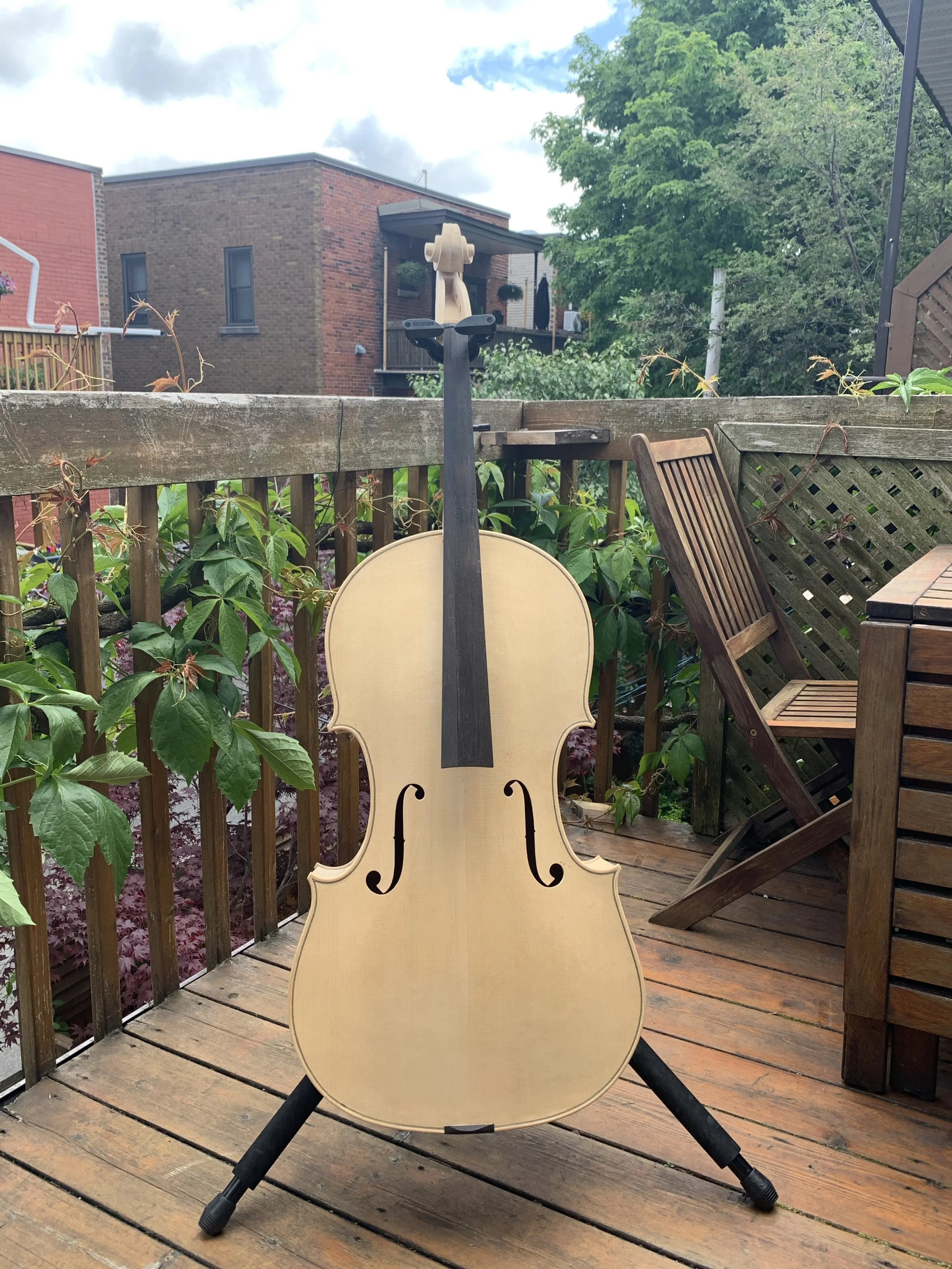
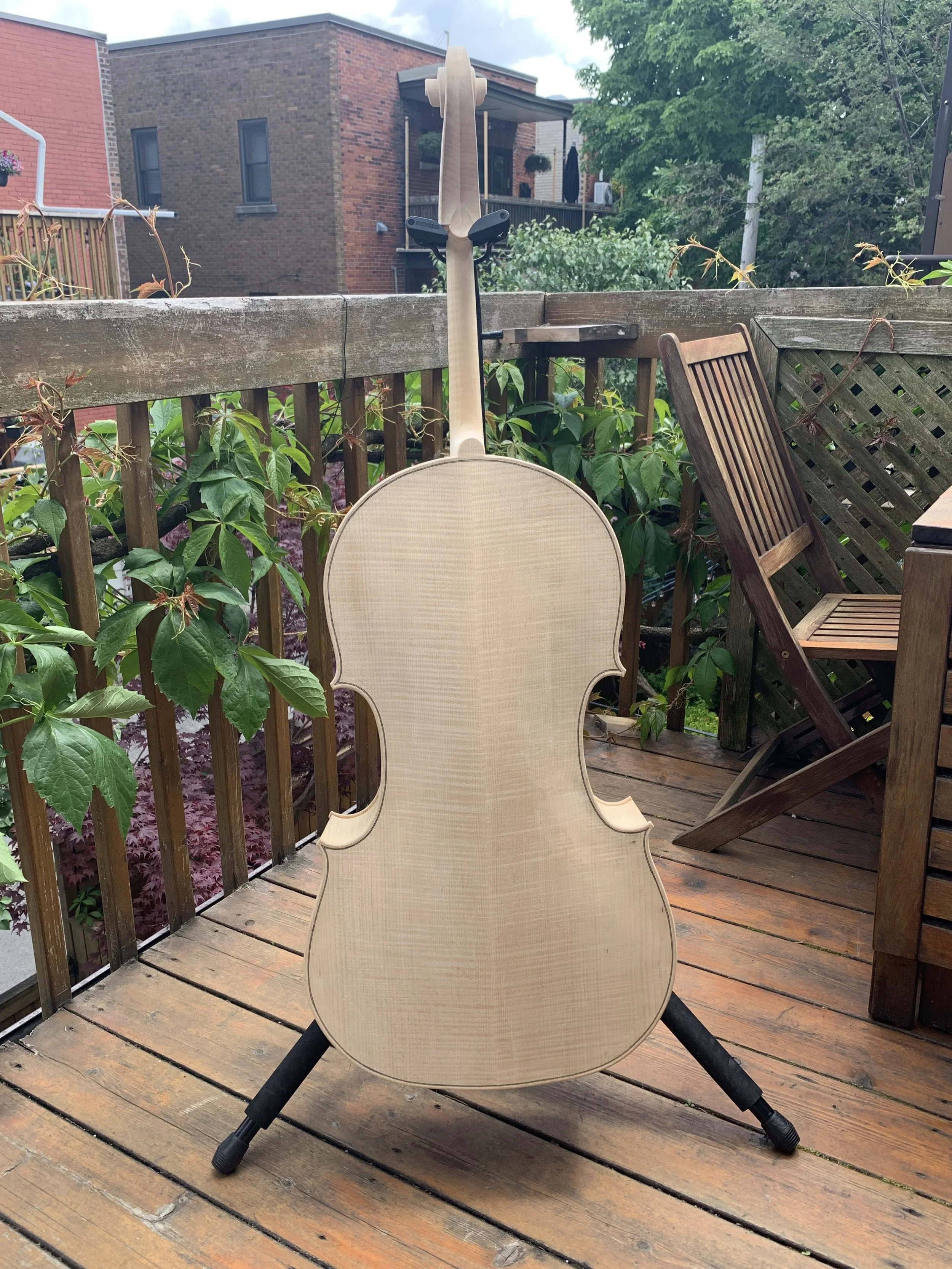
The cello is done “in the white,” which means the varnishing will begin soon. While the cello may appear to be close to the end, the process of varnishing a cello takes several months and it will need to be sunned for a little bit before that can even begin. I was told that this is the old way of doing things and that these days many shops will use drying boxes instead of sunlight. As a person who likes natural things, I am glad to see the cello sunning on Michele’s porch instead of being heated by human-made means. There is no light bulb greater than the sun, after all.
I admit I do not know much about the process of varnishing a cello, but from my own experience varnishing various woodworking pieces in my own home, and from the many youtube videos I have watched on violin making, I know that this is a complicated, multistage process. Here’s an interesting article by British Luthier Robin Aitchison all about Cello Varnish. Luthiers do not all order premade varnish. As I understand it, most serious luthiers each make their own varnish. This is a skill like any other that is honed over a lifetime of research and practice and each maker arrives at a different aesthetic and practical end.

In the great debate about what made Stradivari and the early Italian makers so successful, it was posited that the varnish was the secret to the sound of the old masters. This may be reductionist and perhaps very difficult to prove, since the varnish is just one of so many ingredients that blend to make a wonderful sounding instrument, but in Aitchison’s article he addresses how recipes have changed over time.

If you go to a high end violin shop, or even sit close to the stage at a symphony orchestra concert, you can see the varied colors, textures and transparencies of each instrument’s varnish. The varnish on an instrument contains a bit of its history, not only in the sense that the varnish was made during a particular time when particular knowledge and skill may have been available, but also in the sense that the wear on the varnish of an instrument can describe the behavior of the player. The points of wear over time, evidence of aggressive playing, perhaps even evidence of not having been played at all.
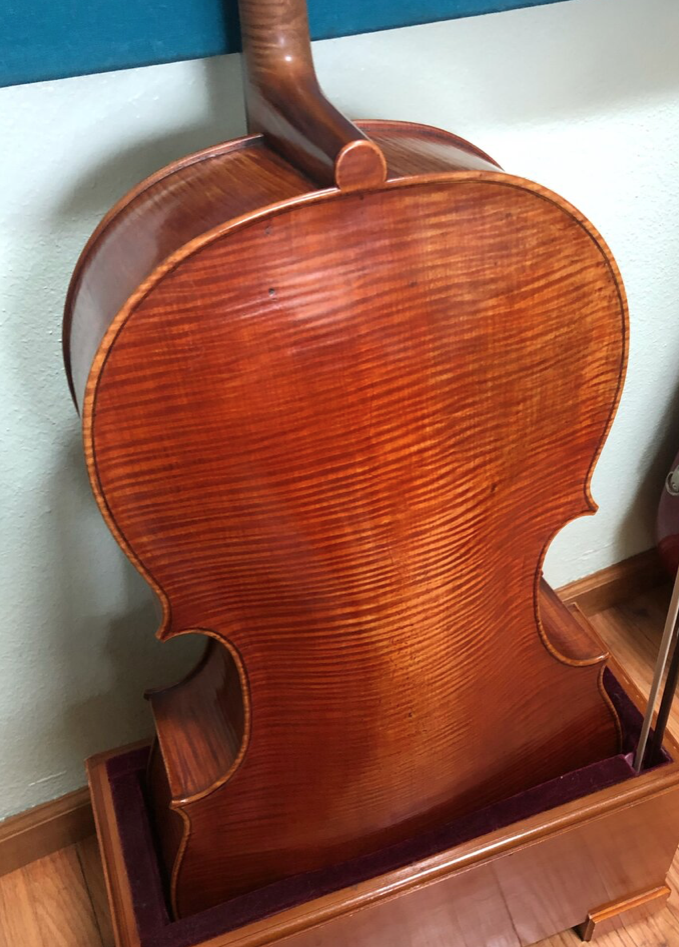
An excellent 2020 Wiliiam Whedbee cello I had the opportunity to break in this year
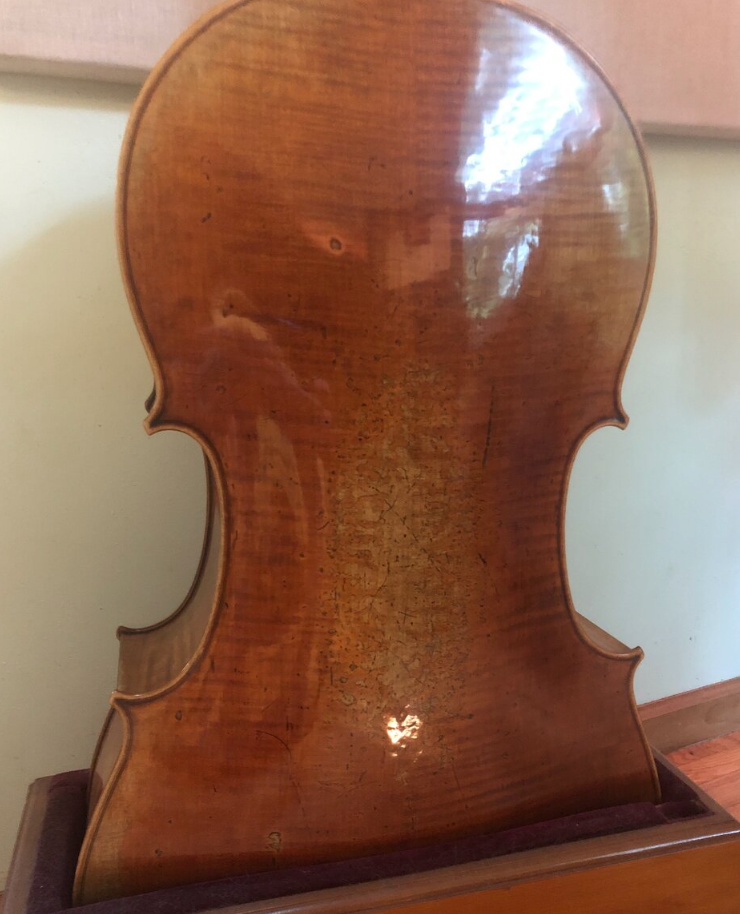
The cello I am currently playing on has a soft, mirror-like varnish and antiquing which replicates tool markings and wear on the varnish that might take place over centuries of use. It was made in 2021 by David Folland (Update: It is now owned by a former student)

My Terry cello had a very matted and even varnish with virtually no antiquing. Over time I wore away varnish on the left side of the cello by resting my hand just to the left of the neck. Other than that there was virtually no wear to the varnish. See below for some examples of Instrument varnish variations.

I happen to have played on several of Michele’s instruments, so I have a rough idea of her varnishing style, but it is unknown how the varnish will transform this particular wood and that’s an exciting mystery.

Top and Back are not Opposites

Below are some pictures of the cello nearing completion “in the white,” which means the body of the cello will soon be closed and the neck affixed to it. The cello will need varnish before the fingerboard, bridge and other fittings are added and this process takes a few months to complete.

I was very struck by the beauty and finish of these pieces. While an instrument with varnish is amazing, there is something very appealing about seeing the raw wood having been sculpted like this. I think it almost seems more real. I’m captivated by the top and the back of the cello for different reasons. The top because of the proportions. I don’t know if I can explain exactly why these particular proportions are appealing, but as it is with any piece of art, it’s hard to truly explain why we gravitate towards it. Perhaps it’s because I know this instrument is going to be mine, or perhaps there is something in the curve of the c-bouts or the ratio between shoulders and hips. Probably it’s a combination of those things. It’s interesting to note that Guadagnini does not seem to have had contact with any of the great master makers of his time and so his instruments are somewhat original in their style even though the workshops of Stradivari, Guarneri and other greats were nearby. It may just be my imagination, but I can see that original figure in the top. Of course this is not a Guadagnini even if it is inspired by one. This is made by Michele and It’s hard to miss her elegant style.

The back is appealing for the same reasons, but I also enjoy looking at the flame and the grain of this maple and imagining how the stage lights will hit it, or the sun through the skylight in my studio. I have always been very attracted to the aesthetic of a beautiful instrument. In another, wealthier, more eccentric life, I could see myself compulsively collecting beautiful instruments just to look at. Of course, most of the beauty is in the sound and that is still an exciting mystery.

Cello for Sale

You have helped get me past the half-way point of my fund raising goal. Thank you so much to everyone who has helped me reach this point. I am lucky to have so many supporters in this. If you’re still interested in donating, please don’t hesitate to do so. I’m not expecting delivery of the cello until the fourth quarter of the year, but that is closer than it seems and hitting my goal early would be great. If you’re new to this page, all of the details of my commission of a cello by Michele Ashley can be found in the first blog post.

My John Terry Cello has arrived at Carriage House Violins and after a neck reset, has been added to their website for sale. The neck reset was meant to raise the projection and to increase the response. I hope it has achieved that goal. My cello, a broad Montagnana copy, stands out as a unique instrument in their collection, although oddly enough they now have two Terry cellos in their inventory. The other was made in 1983 and looks to be a much slimmer Strad copy or perhaps John’s own model. It was consigned very shortly after mine and a part of me is glad they have been united. Below is a photo of my Terry cello from Carriage House Violins’ website. I think it looks spectacular. (Update: The cello is now for sale at Claire Givens Violins in Minneapolis, MN)

A Farewell to my Cello

This afternoon I said goodbye to the cello I have been playing on for the past 10+ years. The cello was made by Luthier John Terry, an Englishman living in Florence Italy. The story was that it was commissioned by the Frost School of music for their cello professor, Ross Harbaugh. It is a bench copy of the instrument he plays on and was delivered some time in 2007 or 2008. Ultimately the school either didn’t want it or could not come up with the money to pay for it and it ended up in limbo for a short time. I never confirmed this story as true, but I have enjoyed spreading it around nonetheless.

In mid 2009, I learned of it and was told it had been sitting in a shop in New York City for a little over a year. A colleague of mine happened to be driving down to the city for the weekend to play a concert and picked it up for me. I played it over several months in various contexts at Eastman and with the Rochester Philharmonic, and then, over Christmas break 2009, I decided to buy it. I wasn’t totally sure about it then and those who have heard me talk about this cello know that it has been a relationship marked by some ambivalence. At times it has been a difficult cello to play and I have felt quite distant from it. During other times it has felt wholly like my own voice. I wanted to make sure I honored the departure of this old friend by reflecting on what this cello has meant to me and what it has done for me.

I played all of my auditions on this cello, the successful ones and the very unsuccessful ones. It went with me to Banff and through Yellowstone National Park where we were very nearly stuck at 11,000 ft during the first big snow of the season. It went to Wyoming with me and the varnish made weird squeaking noises against my sweatpants as we recorded “Cinderland.” It has hung out in the car while I popped into gas-stations across the country for coffee. It has vacationed with me. It has visited with me. It has been with me to all four corners of the country and in doing so it has been jostled about in the back of my hatchback for probably 50,000 miles or so. It has been a total rock through all of that.

I think about the various shows that I have played locally as a member of the Madison Symphony, the Wisconsin Chamber Orchestra, the Willy Street Chamber Players. I think about the various pick-up chamber groups I played concerts with at the Chazen. I think about my recitals at UW and at Capitol Lakes. I think about all of the weddings I have played in not-so-ideal conditions. There are wedding videos of couples I don’t remember who can replay their special day and hear me on this cello. Then there are the more serious recordings this cello has been used for; I never did a full account of those, but needless to say, the two High Plains albums are the most important to me. There is a sonic record of our time together. This combination is something that will never exist again, and that’s a bit glorious, and perhaps a little too sad to ruminate about.

More Pictures of the Cello-to-be

This morning I received more pictures of my cello-to-be. The first photo features the piece of maple that will make up the neck and scroll (left). If you look closely, you can see the profile outlined on the wood. The picture to the right features the spruce top(left) and maple back (right) in their rough forms having just been glued at the center seam. It is inspiring and fun to imagine the cello buried within these rough slabs of wood

Thank you to everyone who has donated thus far. As of today you have helped me reach 51.5% of my fundraising goal!! Your support is so appreciated

The Commission

I have owned my current instrument, a copy of a 1733 Domenico Montagnana by Luthier John Terry, for a little over ten years. In that time it has served me very well. It has been my voice on the stage and in recordings as a member of High Plains, The Madison Symphony, and the Willy Street Chamber Players. It has gone with me to Banff, Wyoming, New York, Boston, Rochester, New Mexico, Iowa, Missouri, Minneapolis, Portland, Seattle, Vancouver, and California among many other places. It has been seen on TV, and heard on the radio, in films and even apps. It has been played at hundreds of weddings, concerts and life events. Through all that it has been a reliable companion.

The instrument is the ultimate teacher, and after ten years of learning what this cello has had to teach me, I am ready to pass this instrument on to someone else and to have something better suited for this stage in my artistic life. In 2018 I won the assistant principal cello position with the Madison Symphony Orchestra. Seeing my efforts pay off was a dream come true and it continues to be one of the things I am most proud of. As the Assistant Principal Cellist of the Symphony and the Madison Opera, I have responsibilities that involve a much more soloistic type of playing. This is a responsibility I embrace wholeheartedly and I need an instrument that is well-suited for this role.

I have decided to ask one of the most highly regarded living makers, Michele Ashley, to make me an instrument. I have known Michele since 2001 when I was studying with David Soyer at Boston University. Mr. Soyer owned and performed on one of her cellos for many years and she would occasionally drop by during my early morning lessons to pick it up for an adjustment.

Michele has focused on making cellos for the past thirty-five years and her instruments are in the hands of orchestral musicians, chamber musicians and soloists across the world. The instrument she will be making for me is based on a 1754 instrument by J.B. Guadagnini, the ‘Girardy.’ This cello is owned by Carter Brey, the principal cellist with the New York Philharmonic. I was able to play on one of Michele’s copies back in 2007 and it left a big impression on me. Michele’s website can be found here.

Giovanni Battista Guadagnini, Milan, 1754, the 'Gerardy'

The initial fee for the deposit has been raised through this fundraiser and now I’m asking for donations to help me cover the balance of the final purchase. The goal I have set for this is $12,000. The bulk of the cost will be covered by me, partially through the sale of my Terry cello.

I am privileged to have had a career that I love, and without a cello, I cannot be a cellist. It is my tool, my teacher and a daily part of my inspiration. Cellos are unfortunately a rather expensive tool and it can be hard to make a purchase like this without help. Donating to this cause will mean so much to me and each donation, no matter the size, will be remembered. Thank you for considering my request and for offering your help.

Sincerely,

Mark