Biking with a cello: Experiment #1 (Is this the right case?)
Few will know this about me now, but when I first moved to Madison, I worked as a bike messenger for about four years. I moved to Madison on somewhat of a whim coupled with a connection I had made with my future teacher at UW. I wasn’t sure if I was going to go back to school for my doctorate, but an open invitation existed and I felt moving to Madison was more interesting than staying in Rochester, NY and easier than moving back to Boston and much less expensive than moving to the Bay Area even though I’d have been closer to family out there. The first year I was here, I spent a couple of weeks on Craiglist looking for jobs. I applied to some things that I was extremely under qualified for like music engraving, and some things that I was overqualified for, including a job that would’ve had me wearing lederhosen on a regular basis. (I got the job, but I bailed before the first shift. I’m not proud of that, but it was probably the correct decision for me) I suppose I was simultaneously over and under qualified for many jobs which I’m sure most musicians will empathize with. Our training is so rigorous that the generalized discipline and detail orientation we possess might make us good at many jobs, but we also have spent so much time on such specific things that we may initially lack specific skills for any given non-musical job.
The job I landed on was working as a sandwich delivery “driver” for Jimmy Johns. I put driver in quotations because all of the delivery was done by bike. I showed up to the JJ on state street, was trained in the art of sandwich making and then sent out into the world to make deliveries. Funnily enough I avoided making my first sandwich for about six months until I was left alone in the store for five minutes at bar time. Someone got the slowest #6 ever made, but I doubt they noticed. I think that was one of about five sandwiches I made during my nine months working at Jimmy Johns, none of which were “freaky fast.”
At the risk of turning this into a much longer post. I met some of my best friends working first at Jimmy Johns and then for Scram! couriers, a messenger company here in Madison. Being a messenger connected me to the city; I have been in nearly every building downtown to deliver either a sandwich, a legal document, medication, lab specimens, live fish….the list goes on.
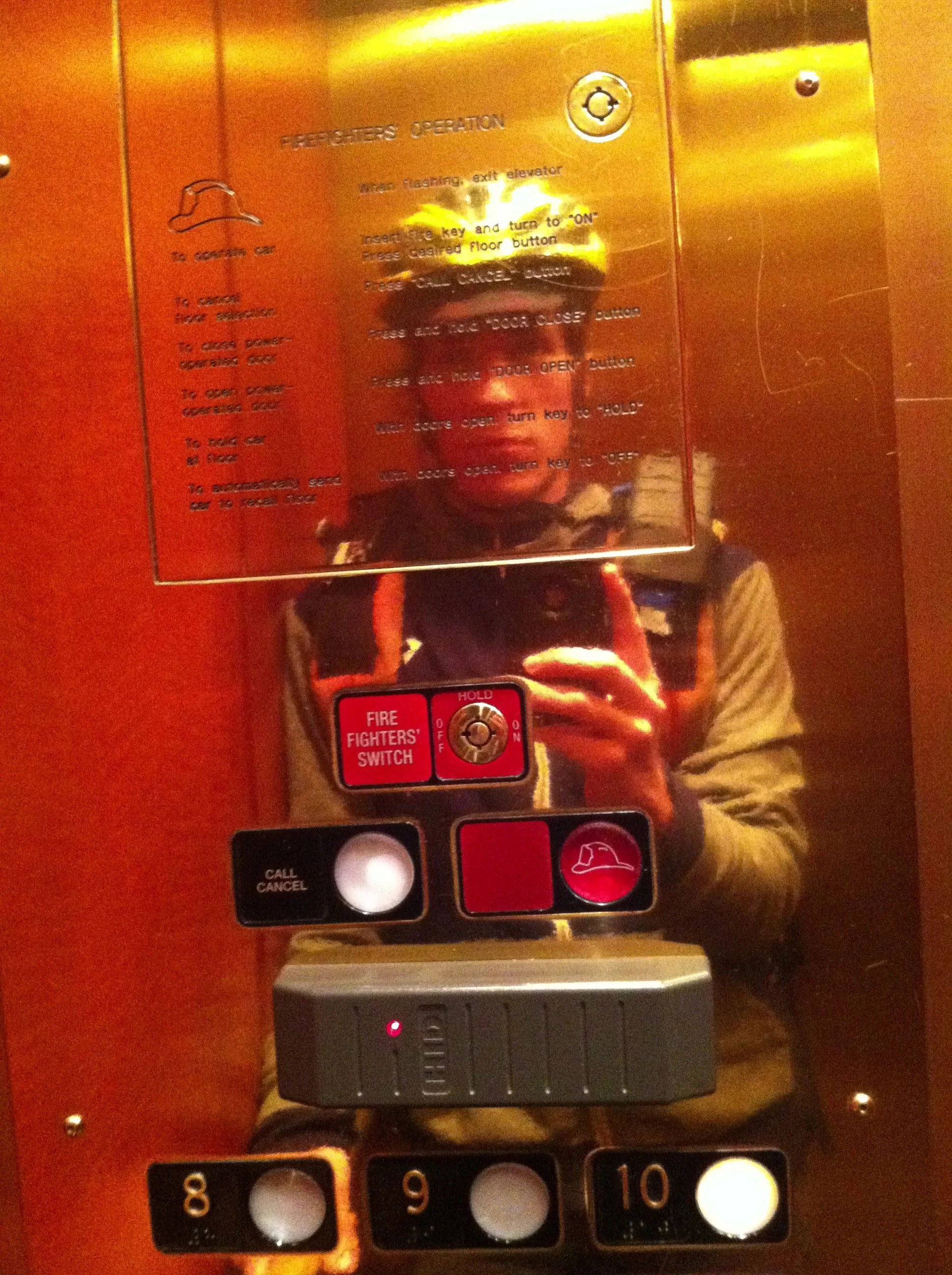
in an elevator in 2012. Bike messengers spend a lot of time in elevators
Doing that job made me feel a sense of familiarity with this city that I know I couldn’t have gotten any other way(Maybe a building inspector? Now that’s a job I am under qualified for) If being a bike messenger was more lucrative than playing the cello, then I would likely still being doing that in some form. Which brings me to the point of this post.
It has long been a dream of mine to commute with my cello by bike. In 2014 I had a bag messenger bag maker make me a kind of cello necklace that would help me clip my cello into my cavernous messenger bag(Pictured below in 2014). It was kind of a goofy design and the cello sat way too high up on my back, so while I did ride around with it a few times, it was never something I could do comfortably. The lack of E-assist also meant that anywhere I went, I would arrive with a serious sweat on. Arriving sweaty is not something I want to do out of consideration for myself and my colleagues and to a certain extent the varnish on my cello.
Currently, when I have rehearsal, I throw my cello in the back of my car and drive roughly 12 minutes to Overture Center. It’s not a particularly difficult commute, but I have continued to come back to the idea of commuting with my cello by cargo bike. It has been an unshakeable feeling and it makes sense given how much joy I still derive from riding my bike.
I find myself on the verge of buying an E-cargo bike to make this dream a reality, but I wanted to blog about the process since the internet has relatively little to say about cello+cargo bike+commute. I’m going to talk through some of the logistical hurdles that I see and as I hopefully progress through this, I will document some of my journey so that others who might want to free themselves from their cars might be ge the courage to do so.
I know that it is much more common to commute with a cello by bike in Europe as this is something I witnessed both in Amsterdam and Germany and know about anecdotally. Madison has excellent biking infrastructure and most of my commute would either be on a path or a protected street, so safety is not much of an issue, though I will get into talking about the safety of the cello itself.
The first issue and thus the first experiment to undertake is one that involves the weather. Cello cases have come a long way, but to my knowledge there are only a few cases that do all of the things necessary to make commuting by bike feasible year-round in a climate like Madison’s. First, the case needs to be weatherproof. This means that it is functionally watertight. I think there are few cases that would not eventually sink if thrown in a lake, but most cases have a seal which makes them impervious to rain/snow. The larger issue with the weather is undoubtedly temperature/humidity. The case that I currently use is a GEWA air which is a polycarbonate case that is light, strong and has excellent insulation properties. The company even touts the R-value of this case, which is not language I have seen anywhere else. A lot of cases are made of carbon fiber for lightness and strength, but carbon fiber is a terrible insulator and such a case would not be a good idea for commuting except in perfect conditions. So how well does my case insulate?
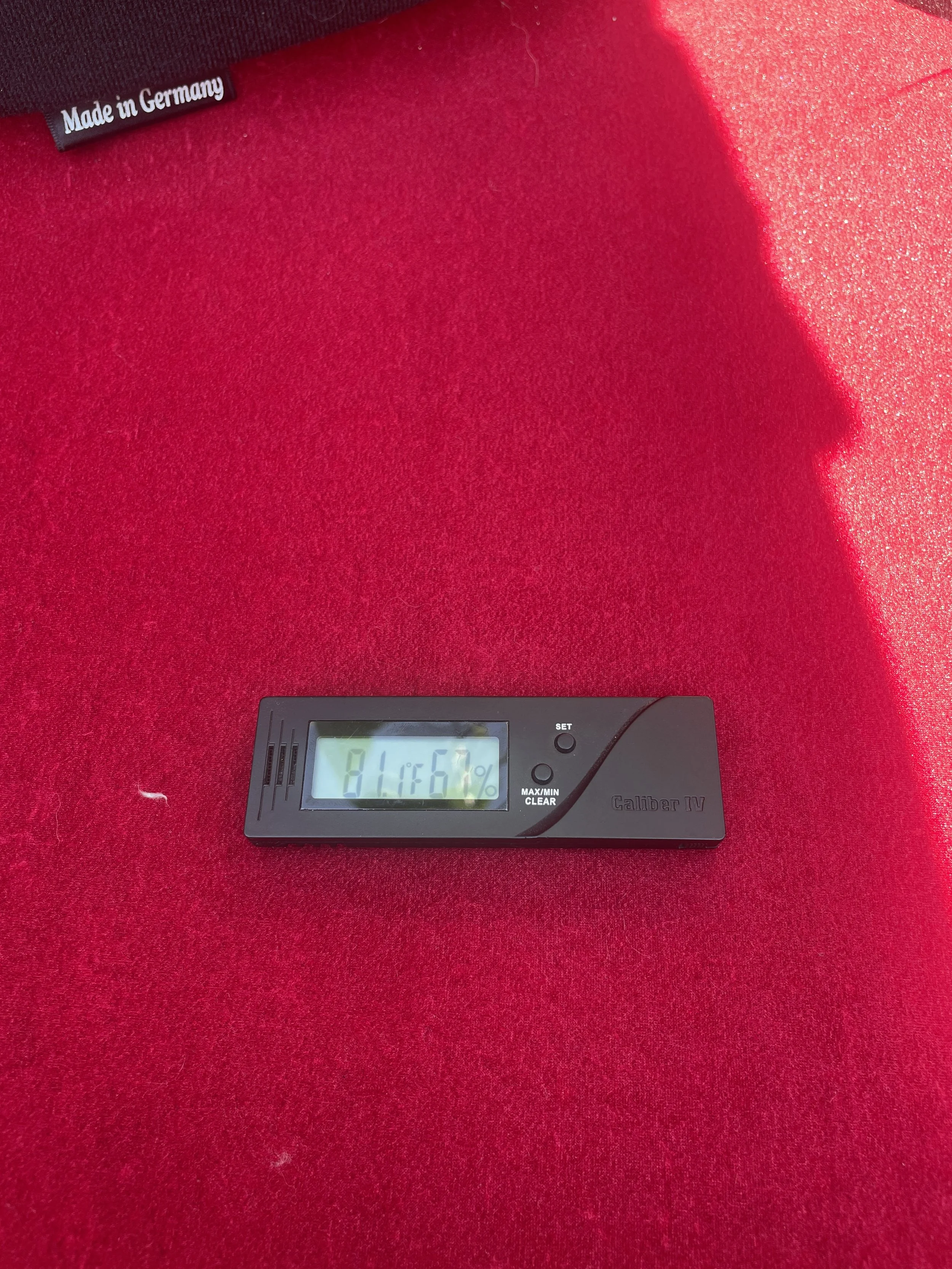
I decided to test out how hot the interior of the case would get after 10/20 minutes of direct sun. With the ambient temperature at 78 degrees f, I set the case (with nothing in it of course) in the direct sun for ten minutes. I put a hygrometer/thermometer in the case to measure the temp when opened. I also decided that it would be interesting to measure the exterior temperature vs interior
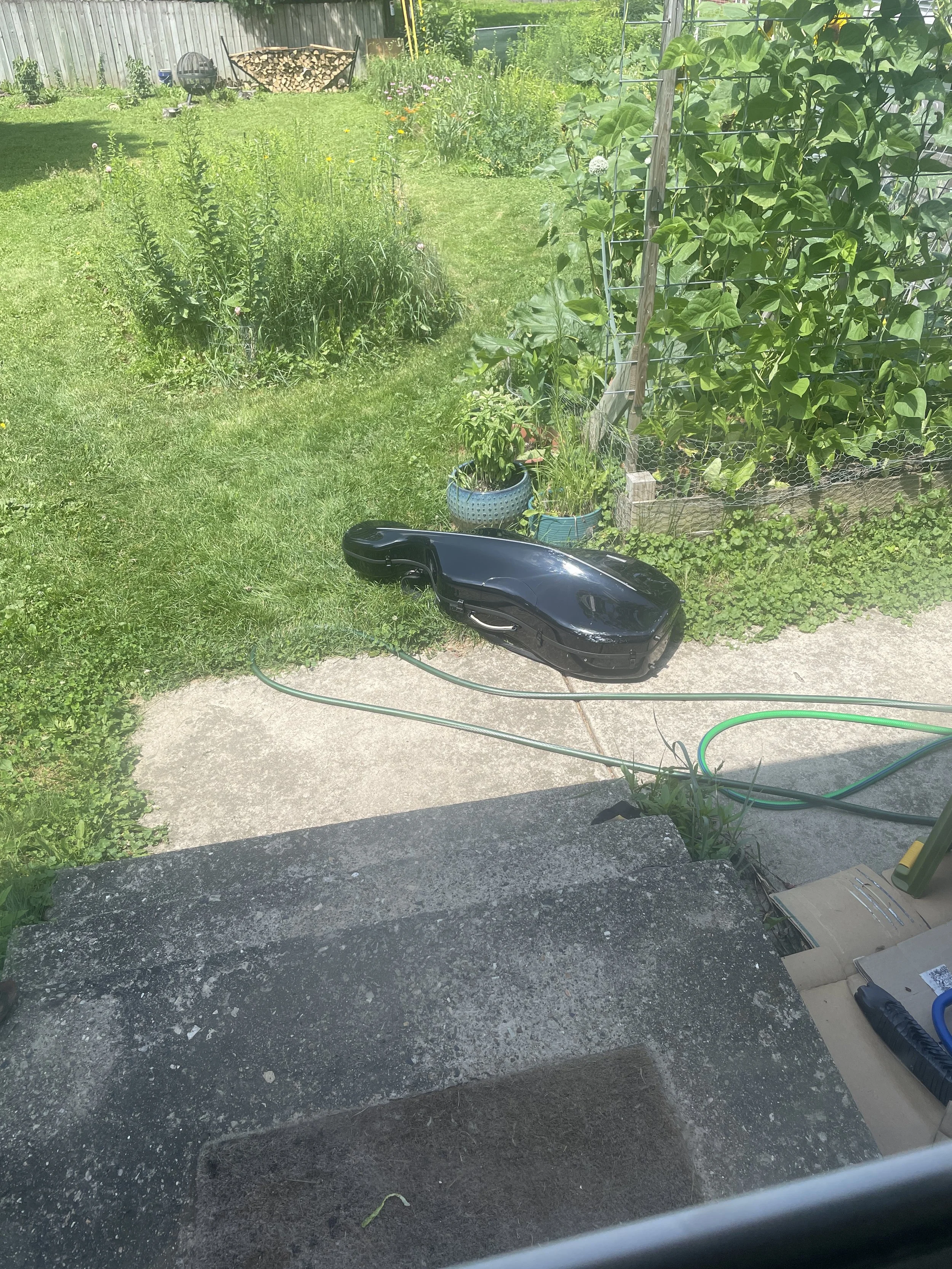
After ten minutes in the direct sun, I measured the exterior with my infrared thermometer and the surface of the case was an alarming 133.5 degrees Fahrenheit. The case is black and so I expected that it would get hot, but I didn’t expect it to get so hot so quickly. Fortunately when I opened it up, it read 81.1 degrees as an interior temperature with a humidity of 61%. The difference between the interior/exterior temps impressed me.
For the second round I put the cello back in the same place for another ten minutes. The sun was out the entire time and the ambient temp was just below 80 degrees. I felt concerned that the case would start to come apart if the exterior continued to get hotter, but I felt it was worth really testing the limit. At the end of round two, the exterior of the case was 144 degrees Fahrenheit.

I decided that in order to get a better interior reading this time I would move the case to the shade before opening it up. Upon attempting to open it up, I discovered that the latch which also contains the combination lock was stuck in a weird way. I suspect this had to do with the heat and that was slightly concerning until I managed to free the latch. This time I used the infrared gun to check the back of the case first. 91 degrees was hot, but not terrible and the case actually felt reasonable to the touch.
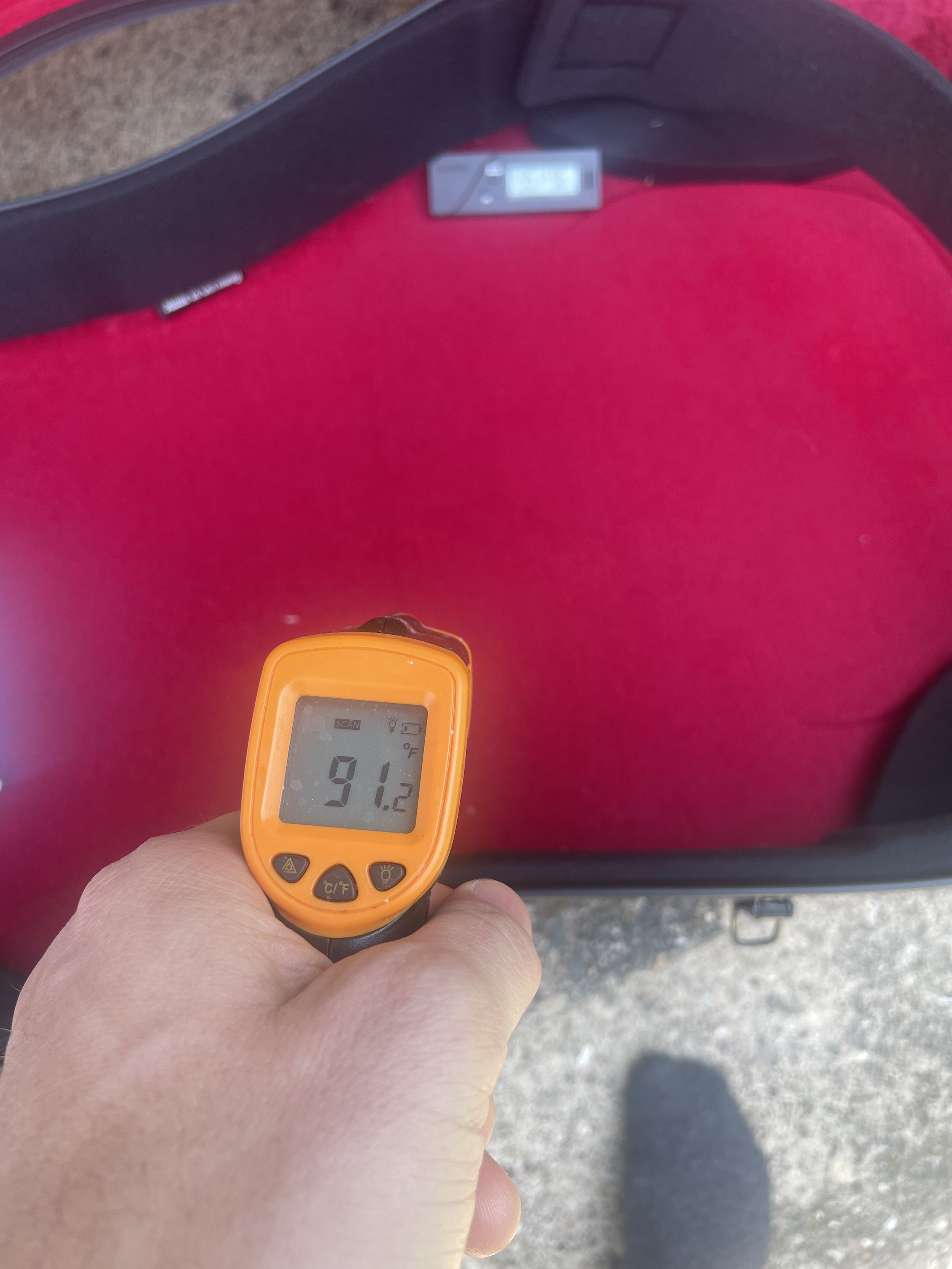
I realized though that the true test would be the inside of top of the case which was exposed to the direct sun. This read in multiple spots as roughly 102 degrees
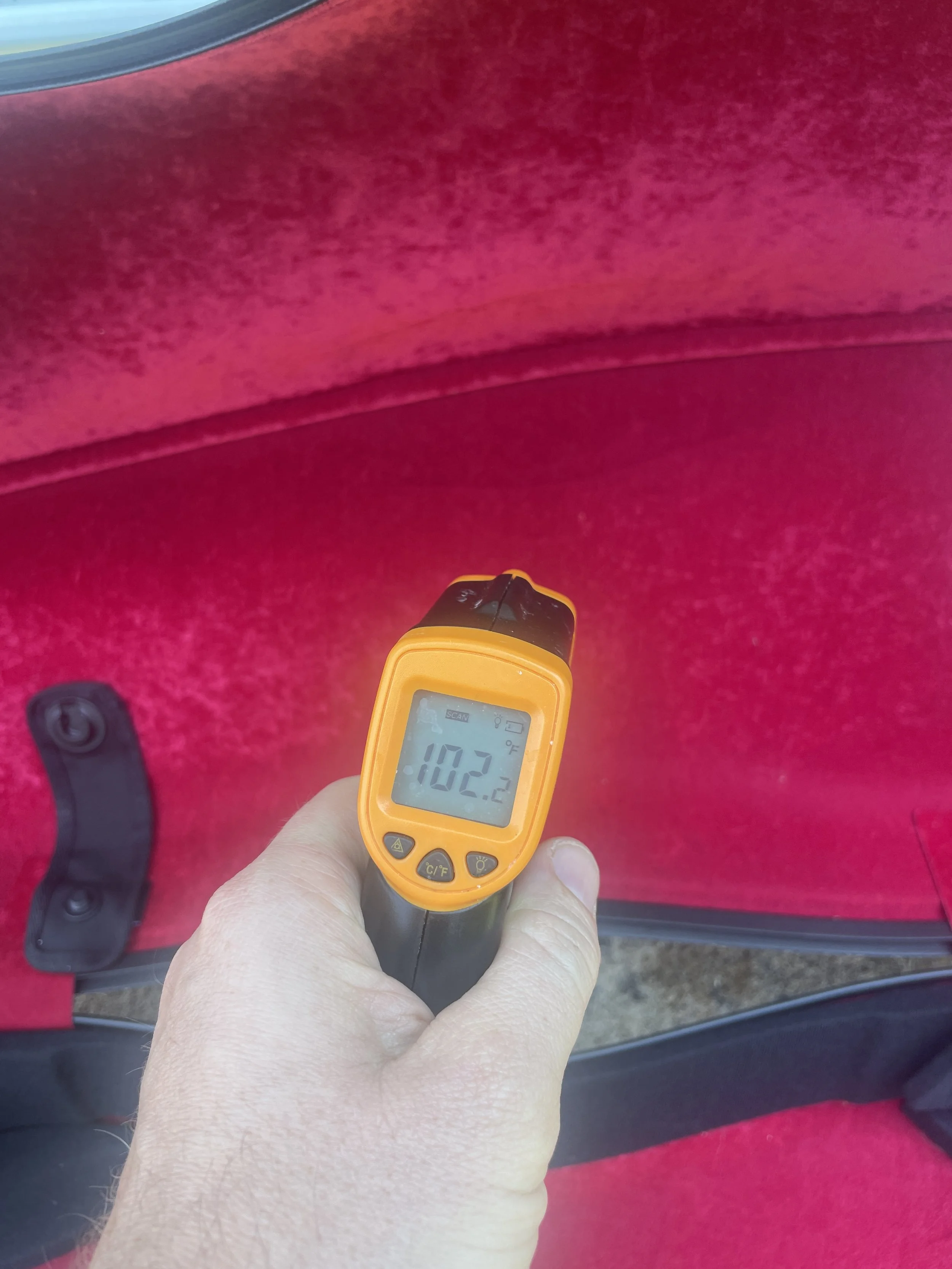
So after 20 minutes in the direct sun, the interior of the case is pretty hot. Probably too hot for a cello, especially one with soft varnish. However, this is July 9th. I don’t commute to Overture in June, July or August, and even if I was commuting, rehearsals are typically at 7pm and I’d be leaving the house around 6:20pm. On top of this, my route is shaded for about 50% of the time. So it’s unlikely that the temperature would ever reach a dangerous level inside the case. The case exterior is another issue that may be solved by simply putting a reflective blanket over it while I travel.
While there are still more questions to be answered before deciding if this is the right case for all conditions, I feel fairly confident that this case can insulate well enough during the time of day/year that I need it. The ideal case would be a white case since it would be much more reflective and that may be the ultimate direction I go, but for now, this equipment is not going to get in the way of my adventure, at least not from a temperature standpoint
The next questions I will have to answer are these:
How will this insulate in the cold? Most of the symphony season is spent in temperatures below 45 degrees, so there’s a question of cold transfer, especially when it’s below freezing. I do have a silk bag that the cello can go inside and the tight weave helps delay the transfer of cold to the cello itself, but this is unknown. I need someone with a walk-in freezer to help me with this next experiment.
How would it deal with a collision. Biking is inherently riskier for the instrument. I am a very confident rider, but accidents do happen. In fact the skin on my ankle is still healing from a bike accident last September. Not much blood flow to that area. In any case, how do I test the impact absorption of this case? My intuition tells me that the case would likely survive any impact, but the cello might not be so lucky. Certain cases flex more than others and I’m not convinced this one would do the trick in the case of an accident. I would love to take a sledge hammer to this case with a bricked cello on the inside. If you’re reading this and you want to sacrifice a GEWA air and a junk cello that is no longer playable, please contact me. You can even appear in a video with me using various heavy items to try to destroy this contents of the case.
General shock absorption. Riding a bike can be bumpy. The roads here are far from perfect and a cello being jostled around for 20 minutes each way four nights in a row will likely not be great for the adjustment of the instrument. I know that this case is not capable of absorbing those shocks. I will be experimenting with tire pressure I’m sure, but ultimately I will have to build some kind of a shock absorbing sled for the cello to sit on, either as I carry it with my backpack straps or ideally as it lays on it’s back on the cargo rack of the bike. I will document that project as I go, and who knows, maybe I’ll even make some youtube videos about that too
Does my instrument insurance cover travel by bike? Not a particularly flashy question, but if you break it and it isn’t covered you’ll be very sad, and also very broke. Instrument insurance is notorious for not covering air-travel and it would not surprise me if travel by bike was also exempt from the policy in some way. This is a question that I can probably answer fairly easily by calling Clarion, but it’s a question that needs to be addressed before I feel comfortable enough e-biking with my cello. If I need to change my insurance, that’s something I’m willing to do
Alright, that’s all for now. If you’re reading this and want to leave a comment, please do.